





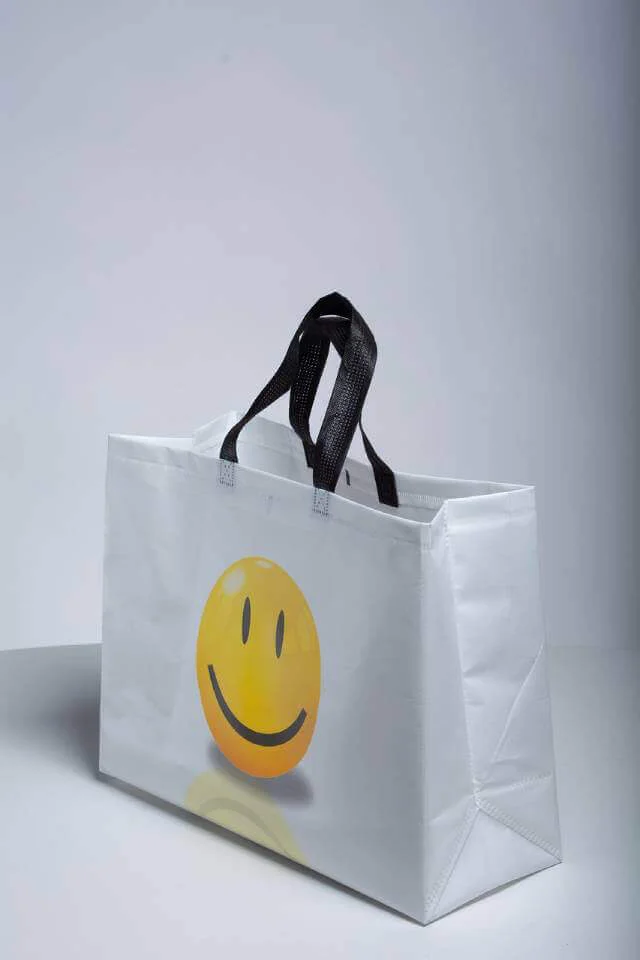
Everything you need to know about personalized TNT shopping bags.
Do you own a business and are considering purchasing affordable personalized shopping bags , perhaps made of non-woven fabric? They're a great way to advertise your business: the current market rewards brands that successfully enhance their image. Investment in corporate marketing highlights appealing aesthetic solutions, such as products with a simple yet intriguing design, perhaps even ones that raise the company logo's profile. The modern image-driven business landscape offers virtually limitless solutions. Companies distribute personalized merchandise at every opportunity, be it trade shows or meetings. From t-shirts to pens, even shopping bags. The latter are becoming increasingly popular. They come in a wide variety of shapes, materials, and colors. In recent years, alongside those made from more traditional fabrics, non-woven shopping bags have become increasingly popular, enjoying ever-increasing success. But what makes this type of bag so sought-after?
From traditional fabric to TNT: a true revolution in shopping bags.
To better understand the growing popularity of printed nonwoven shopping bags, it's important to discuss the underlying technological innovation. TNT is an acronym for "Non-Woven Fabric ." This innovation comes directly from the industrial world, where it has found success in various sectors, from construction to agriculture to textiles. Its impact has been particularly significant in this sector. Nonwoven fabrics rely on the properties of materials other than traditional ones. Their unique characteristics therefore require special, technologically advanced manufacturing techniques. Following a millennia-old tradition, traditional fabric is simply the result of a perpendicular weave of threads that converge in what is called the weft. This technique is the same one historically used for wicker baskets and was the basis of looms. With the advent of modernity and technological advances, traditional weaving has been joined by new fiber processing methods, as well as the introduction of a new class of materials: synthetics. These materials have a very precise and organized structure, very different from that of natural fibers like cotton. Fibers thus composed must be subjected to intense heat, chemicals, or pressure to be processed. When treated in this way, the fibers combine into a material that doesn't adhere to a precise structure, like a classic weave, and therefore can't be called a fabric. What you get is something extremely similar: a nonwoven fabric. Over time, the production of nonwovens has reached highly advanced levels. The combination and evolution of production techniques have further differentiated the resulting products, making them suitable for a wide variety of uses. The success of nonwovens lies in the long list of advantages linked to their specific characteristics, including extreme versatility. The first, enormous advantage offered by nonwovens is their versatility. The applications and variations on the theme are virtually limitless. Depending on individual needs and intended purpose, the product can be designed for greater resistance or elasticity. Fireproof, absorbent, or, conversely, completely waterproof: the more the merrier. Following modern environmental awareness campaigns, the enormous interest in nonwovens is justified by their extremely high level of reuse , a significant advantage in terms of combating waste and pollution. Traditional fabrics, in order to be reused, must undergo lengthy and highly expensive specific treatments and processes. With nonwovens, however, the situation is more straightforward: the lack of an actual weave accelerates the breakdown of the fibers, which can then be reprocessed. The entry into the nonwoven market, a product that makes customization its forte, has attracted the attention of investors intrigued by the creative potential offered by this material. The ability to commission merchandise, such as personalized reusable shopping bags, unique in size, shape, and technical qualities, resulting from a project carefully designed and developed from scratch, has opened the marketing landscape to new horizons.
What advantages does the TNT shopper offer compared to the cotton one?
The essential strength of a non-woven shopping bag lies precisely in the unique, highly modifiable nature of the material it is made of. Every company has different needs, which translate into different characteristics to be applied to their shopping bag. Non-woven fabric allows for the creation of bags without any design limitations, providing consumers with a finished product that perfectly expresses the spirit of the brand. In addition to aesthetic characteristics, structural features can also be carefully considered, placing greater emphasis on resistance per weight rather than elasticity. The difference between cotton and non-woven shopping bags revolves around the possibilities offered by the material. While non-woven fabric, as mentioned, lends itself to virtually unlimited uses , cotton often presents limitations that are detrimental. A cotton shopping bag may be visually pleasing and may be well-made, but it will always offer a limited range of action. Non-woven shopping bags are less affected by the passage of time. They can be optimized during the design phase in terms of resistance and sturdiness, maintaining their load-bearing capacity over time. Nonwoven fabric has another very interesting feature: it's easily washable. The lack of weft, along with the possibility of reinforcing the nonwoven structure for water repellency, ensures that the bag can be easily cleaned without retaining water. Many will be able to see the tangible effects of the ecological approach we suggested above. Nonwoven bags are durable and reusable, and they're also completely recyclable. Here too, the nonwoven bag seems to outperform its cotton counterpart. As we've seen, it's the complex weave of the traditional cotton bag that makes it less recyclable. Speaking of costs , another definite advantage of choosing a nonwoven bag is the financial investment, which is significantly more limited with nonwovens. When considering the quality-price ratio, a nonwoven bag can offer a series of enviable advantages at a much more competitive price than cotton. Greater elasticity, lightness, reduced abrasiveness and softness, and consistently appreciable breathability. All this, combined with extremely long-lasting durability and extreme recoverability, from an eco-sustainable perspective, non-woven shopping bags are gaining significant traction. They are primarily sought after by companies aiming to manage their marketing projects from scratch and offer the public a customized product. When it comes to expanding their brand, the most important aspect to address, especially for gadgets like shopping bags, is the imprint of the company logo. Designing the logo is obviously the company's responsibility, but implementation is far from simple. Printing on non-woven fabrics requires the use of special inks. If treated like a traditional fabric, such as cotton, the print quality may be subpar and the fabric may quickly deteriorate. To overcome these problems, you can contact burger-print.nl , our company specializing in professional screen printing. Specifically, we offer a web-to-print service : all product purchasing is done online on our website. You can choose from a myriad of nonwoven models, each with its own technical and aesthetic specifications, within a fully-fledged digital storefront. After choosing the model and features, you'll be asked to select the design you want printed on the bags. After completing the final steps, you can proceed to payment, which can be made online (100% prepayment) or partially online and with cash on delivery (70% prepayment and 30% on delivery). The bags will be delivered to the address of your choice in a very short and competitive timeframe. Costs can be further reduced by paying a small surcharge.
How much does it cost to make custom shopping bags?
There are dozens of affordable personalized shopping bags (made of nonwoven fabric, cotton, or other materials like jute) available on burger-print.nl . You can find large, medium, or small ones, with handles of varying lengths, in a single color or with contrasting chrome plating. The most exciting aspect, however, is the prices. Prices range from €1.49 for an order of one hundred small bags made of 100% polypropylene nonwoven fabric (measuring 25×35 cm) with handles, to €2.16 for an equivalent order of the glossy laminated nonwoven fabric version (42×38 cm). What's more, printing is included in the price regardless of the model you choose, starting from a minimum order of 50 pieces. And shipping? Always included regardless of the number of pieces ordered. As mentioned above, the printing will be done via screen printing, a cost-effective technique with excellent visual quality, as well as quick to complete, allowing for very rapid delivery times (around eleven business days). Burger Print extends the quality of its service to in-depth customer service. For this reason, it maintains a 24/7 customer care service. After this analysis, the reasons driving more and more companies to invest in the creation of personalized shopping bags are clear. The gain in terms of long-term visibility and brand awareness, printed on nonwoven bags, fully repays the cost of the merchandise. Distributing the shopping bags at trade shows and conferences allows for effective marketing campaigns at virtually no cost. The owners of the bags you design will carry your brand with them, displaying it wherever they go, even at the supermarket when they shop.
What are you waiting for? Order your personalized TNT shopping bags now at burger-print.nl : choose quality at truly affordable prices!