





Are you printing on T-shirts and don't know where to start? First, depending on your budget, the quantity of items, and the graphics you want to print, you'll need to learn about the main printing techniques available for fabric printing. Take a few minutes to carefully read our quick guide; afterward, everything will seem easier.
To go from the guide to the catalog, start from the personalized t-shirts page: from there you can choose men's, women's, or children's and configure the quote online.
SILKSCREEN PRINTING
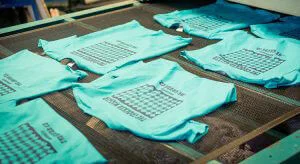
Screen printing is the most commonly used technique in the T-shirt printing industry.
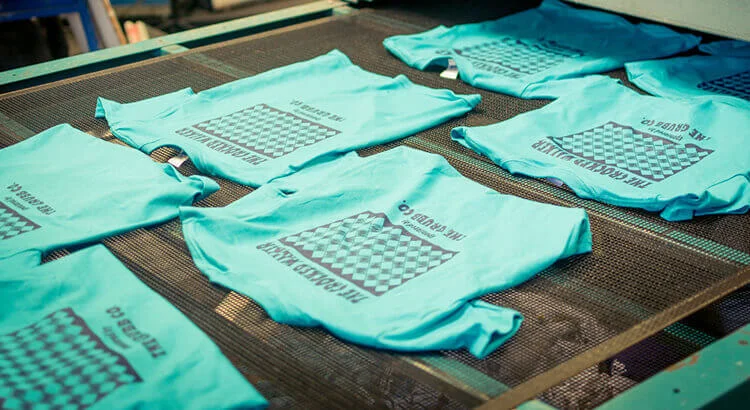
First, the design to be created is broken down into primary colors using special software. Next, the printing screens are developed (one for each color), which are placed on the screen printing carousel. Once the screens are positioned, printing begins on the products, which will then undergo a further step in a special oven to bond the inks to the fabric.
- PROS: It's an ideal technique for large print runs, especially for very simple designs, because it allows for economies of scale and consequently low costs. Highly wash-resistant, it can be used on any type of fabric with excellent results.
- CONS: Since screen printing involves some fixed costs (for example, the cost of making the frame), it is uneconomical and therefore not recommended for orders below a certain quantity. Furthermore, costs also vary based on the complexity of the design to be created and the number of colors it contains.
Here is a selection of products ideal for screen printing:
No products found.DIRECT DIGITAL PRINTING
This T-shirt printing technique is a recent development and has only been developed in recent years. The process is very similar to what you do at home or in the office, printing text or images on sheets of paper and then transferring them to a T-shirt printer. The difference lies in the machinery used: instead of printing on paper, it prints directly onto fabric, using special inks. In this sector, two leading companies produce highly technological machinery capable of producing high-quality digital prints: Kornit , an Israeli company, and Aeoon , an Austrian company. We do not recommend digital printing if your supplier doesn't have one of these technologies.
- PROS: It's an ideal technique for creating any type of design, and printing is even excellent for high-resolution photographic images. Another advantage is the flexibility of this technique, which allows you to print even a single piece at a reduced cost. There are no additional fixed costs beyond the printing fee, and the color results are truly exceptional.
- CONS: The wash resistance of direct digital printing tends to be lower than that of screen printing, which we might call eternal, but is still long-lasting. The costs of this printing technique do not allow for economies of scale as the quantity purchased increases. For large quantities, it could become more expensive compared to screen printing, especially for simple designs. It is very difficult to achieve good results on synthetic fabrics.
HOT APPLICATIONS
This is the technique through which thermo-adhesive films are engraved using a cutting plotter and then subsequently applied to the fabric using the heat of a heat press.
This technique is simple, as is the design to be printed, preferably in one color.
- PROS: Low cost, it offers the advantages of transfer and allows you to print very simple designs even on a single garment.
- CONS: Even if applied well, it tends to crack and deteriorate, given its poor resistance to washing over time. The color choice is usually limited to the film colors available from the manufacturer.
Considerations – It is suggested not to consider this technique if direct digital printing is available.
EMBROIDERY
Embroidery is commonly used to create small logos, and the result, when applied by true professionals, adds prestige to any garment . This technique is typically used to personalize uniforms or professional clothing (hotels, restaurants, yacht clubs, etc.), with the aim of adding value to any garment, offering that extra something compared to digital or screen printing.
- PRO: If the embroidery is done properly, the result is truly exceptional.
- CONS: The construction costs are high and it also includes various fixed installation costs.
SUBLIMATION PRINTING
This technique is primarily used to create all-over prints, meaning prints spread across the entire garment. It is usually performed before the product assembly stage and immediately after the fabric is cut. The print is created on special paper using plotters loaded with specific inks. A heated calender is then used to unroll the printed paper and laminate it to the fabric to be printed. Upon exiting the calender, the fabric will have absorbed the ink released by the paper due to the temperature. This technique can also be used on ready-made garments, but this will inevitably result in defects due to the irregularities of the fabric once assembled.
- PROS: The result, in terms of color brilliance, is astonishing. It allows you to print the entire garment and any type of design, without any limitations on shading, details, or the like.
- CONS: Being a very expensive customization system, it must be applied before the product is assembled. It can only be applied to fabrics with a high polyester content or synthetic materials in general.
Now that you have a clearer idea, visit our Burger Print website to print your t-shirts online!