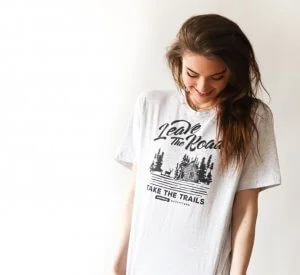






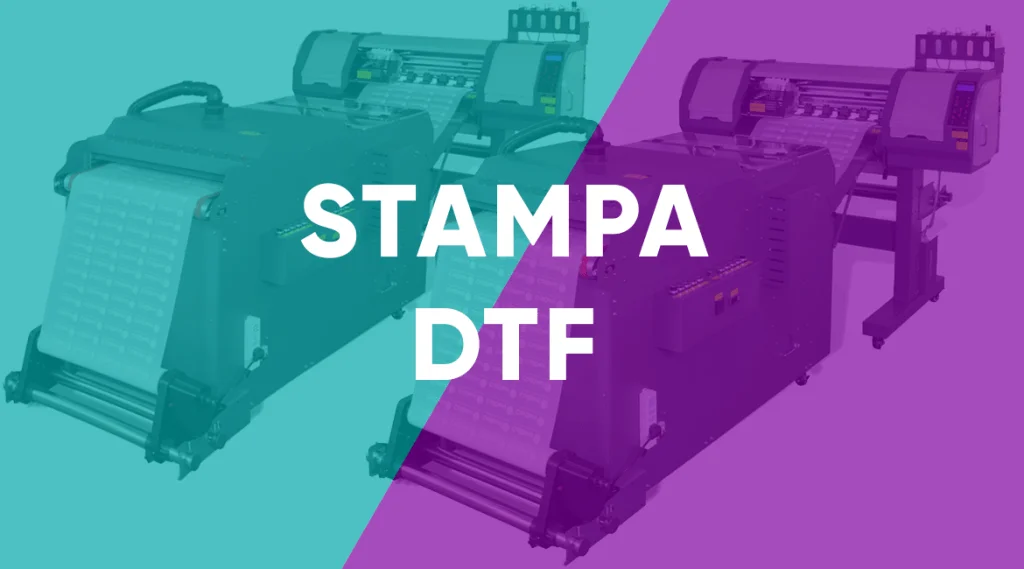
The personalization of clothing and gadgets using DTF printing can be considered a technique that solves many of the problems encountered with other types of printing. To fully understand its potential, let's take a look at exactly what it is, how the entire process works, and what its advantages are.
What is DTF Printing?
DTF is the English acronym for Direct-To-Film, or Direct-Transfer-Film, which translates into Italian as printing directly onto film.
The name itself defines the main difference between this technique and others. Using special printers , the customized design or motif is first printed on a PET (thermoplastic polyester) film, usually around 0.75 mm thick, and then transferred to the object to be customized , be it an item of clothing or a gadget.
If you already have a DTF printer, remember that you can find TOP quality consumables at exceptional prices with us.
No products found.Colors and Inks Used
Direct-To-Film involves the use of special water-based inks, with printers usually configured for four-color printing, to which the use of white is added (hence the acronym CMYK+W, or cyan, magenta, yellow, and black, with the subsequent addition of white).
Printing is therefore based on the use of 5 colors in total . The CMYK ink set is applied first, to then be covered by a second pass (wet-on-wet) of white ink which will act as the base for the design.
There are also more advanced machines that feature configurations with additional colors, in order to expand the range of achievable colors (i.e., the gamut , or set of hues a printer can reproduce). One of these possible configurations is called hexachrome, meaning the availability of six colors . Specifically, in these cases, we speak of the CMYKOG color group (cyan, magenta, yellow, black, orange, and green) or CcMmYK (cyan, light cyan, magenta, light magenta, yellow, and black) color group.
Due to the different operation of the machines, the same inks cannot be used in DTF printing as in DTG printing (i.e. Direct-To-Garment, in Italian direct printing on fabric).
This means that the same design, printed on the same material but using two different techniques (and therefore with two different types of inks), may appear slightly different in terms of brightness and vividness of the colors.
The DTF Printing Process in 7 Steps
If we assume we want to customize a t-shirt using DTF printing, here's how the whole process would unfold:
- Printing : A dedicated DTF printer prints the design onto the film using special water-based inks. The initial print will obviously present the design upside down compared to the orientation in which it will be applied to the final garment.
The printer will perform a first pass of CMYK colored inks and a subsequent overlay pass of white ink, which will have a dual function. On the one hand, it will create a base to highlight the colors and make them as vivid as possible, and on the other, it will act as a bonding point for the glue. - Adhesive powder application : A special adhesive powder is applied over the printed film to act as a glue. The adhesive powder will adhere only to the printed areas, taking advantage of the moisture in the freshly printed ink, while the excess is removed using automatic shakers. Different types of glue exist depending on the type of substrate being printed. The quality of the powder applied will influence the final result and the feel of the printed design.
- Polymerization of the adhesive powder : The printed film coated with adhesive powder is placed in an oven. It is heated to approximately 120°C for the time necessary to polymerize the powder, which will then form a single layer with the ink. This transforms the glue powder into a homogeneous film.
- Film preparation : At this point, the actual film printing production phase is complete. For third-party supplies where only printing is required, the film will be wound into reels and shipped directly. Where application of the printed film is also planned, an additional step is required. The film is pre-cut to obtain the individual prints to be applied later.
- Garment preparation : It is extremely important that the garment is completely crease-free when the film is applied. To this end, it is common to prepare the garment by ironing it with a heat press for 2 to 5 seconds. The heat press will also help dry any residual moisture trapped in the fabric, as well as any residue from chemicals used during the manufacturing process.
- Film application : This is the actual moment when the pre-cut film is applied to the T-shirt. The garment is then placed on the heat press, the film is positioned in the desired area, and the entire garment is pressed. Times and temperatures depend on the type of substrate used, but we can use 160°C for 15 seconds as a guideline.
- Resting phase and film removal : once the print has been applied, the film can be removed. The removal method depends on the type of film used. There are two main types: hot peel, which involves hot peeling, and cold peel, which involves cold peeling. Although the hot peel type, introduced more recently, speeds up the process (since it doesn't have to wait for it to cool), one cannot be said to be superior to the other. Much will depend on the application method and the printer's needs. At Burger Print, we tend to favor hot peel films.
Advantages of DTF Printing
Compared to other printing methods such as screen printing or DTG, Direct-To-Transfer stands out for a whole series of advantages. Among the most notable are:
- Greater flexibility of use : the fact that the actual printing process occurs on a film that is then applied to the object or garment makes customization extremely flexible. Not only does this printing adapt very well to any type of fabric (cotton, but also nylon, polyester, silk, etc.) and other materials (such as glass, wood, and others), but it also makes it easy to personalize areas that would otherwise be difficult to reach with other printing techniques.
- Greater precision and image definition : while with other printing techniques such as screen printing it is often recommended not to include very small details in the design, with Direct-To-Film it is possible to reproduce details of just a few millimetres.
- Durability over time : It's a misconception that DTF equates to fragility. The durability of a design printed using the DTF technique is excellent: the applied design doesn't show any cracks or crazing in the medium to long term and resists washing very well . This makes Direct-To-Film a particularly suitable technique for customizing garments or objects subjected to heavy use, such as in the HoReCa (hospitality) sector, i.e., use in the hotel industry, or for workwear in general.
Speed of execution : It's common to read that DTF printing boasts greater speed than other techniques. In reality, the issue is slightly more complex. Much depends on the type of machinery and the available workflow solutions. Generally speaking, the entire DTF printing process is much faster to complete than its sister technique, DTG. It doesn't require a pre-treatment phase for the garments, nor a double pass when printing on dark garments. Screen printing, however, remains the leading technique in terms of speed and productivity, even compared to DTF printing.
Ecology: Pros and Cons of DTF Printing
Considering the environmental aspect, two important issues regarding DTF technology cannot be ignored. One for and one against.
On the one hand, DTF printing is much more eco-friendly than other techniques. This is because the amount of ink consumed by DTF printers is significantly less than that used by other types of printing.
But on the other hand, the DTF printing itself will produce a waste that is not present in other techniques: that is, the PET film itself.
Conclusions
DTF printing is a very recent technique, perhaps the youngest among the methods for customizing garments and objects. Despite this, it is rapidly establishing itself as one of the benchmark techniques, thanks to its numerous advantages.
But this doesn't mean that it should always be considered the best choice, or a type of printing that will replace all others.
DTF, DTG, screen printing, and laser engraving are not mutually exclusive, but rather complementary: each meets a different printing need.
However, we are confident that DTF printing has enormous potential for development, and we are curious to see how its use will evolve in the future.
Through the Burger Print catalog you can seize a double opportunity : the advantages of Direct-To-Film combined with a wide selection of clothing and objects at the lowest prices on the web to customize.
All text and photos on this page are licensed under the Creative Commons Attribution-ShareAlike 3.0 Unported License .