





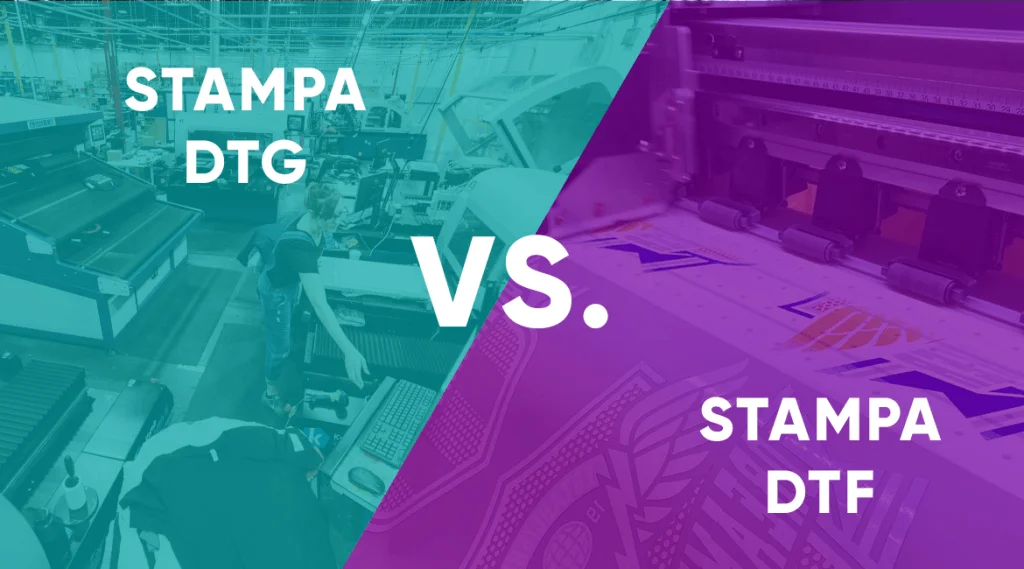
Direct-to-fabric printing and direct-to-film printing can be considered close siblings. That's why when we talk about comparing the various custom printing techniques, these two immediately come to mind. Here's a comprehensive comparison of DTF and DTG printing.
DTG vs. DTF Printing: Two Different Operating Principles
Many of the differences between these two techniques stem from the different principles on which they operate. On the one hand, we have a customization technique that involves printing directly onto the fabric (DTG, Direct-To-Garment) .
This technique has been on the market for over 20 years and is now an industry standard. On the other hand, we have a technique that involves printing on a film, the custom design of which is then transferred to the custom T-shirt. This technique is much more recent , having only been on the market for a few years, and therefore has much potential to be developed and realized.
How to Compare the Two Techniques
Since these two printing techniques are similar, they have much in common. But at the same time, they are also very different. We can therefore make the comparison between the two concrete by breaking it down into practical cases.
Specifically, we will see how the two techniques behave in relation to:
- Printing flexibility (fabrics, areas, volumes and related costs)
- Speed
- Sustainability
- Sensation of touch
- Print durability
Printing Flexibility
Printing flexibility is one of the areas where the differences between the two techniques are most noticeable . To analyze this point, it's best to divide the concept of flexibility into three more concrete categories, such as:
- The ability to print on different fabrics and materials
- The ability to print on certain hard-to-reach areas
- Adaptability to print volumes and costs
In two of these three cases, DTF printing has something extra. Let's look at each one in more detail.
Ability to Print on Different Fabrics and Materials
DTG printing is a technique that, as its name suggests, can only be applied to fabrics and not to materials like ceramics, plastics, or metals, unlike DTF printing. But even if you simply consider fabric as the only material you can print on, Direct-to-Garment suffers from a certain limitation regarding the types of fabrics it can print on.
This technique, in fact, is usually used to personalize garments made of natural fibers, such as cotton, hemp, and bamboo.
DTF printing , on the other hand, precisely because it doesn't print directly onto the fabric, is better suited to customizing garments made of nylon or other synthetic fibers , such as polyester. However, unlike DTG printing, it can also be used to customize materials other than fabrics, and therefore can also be used to print on gadgets and objects.
Ability to Print in Hard-to-Reach Areas
Even in this case, where Direct-To-Film seems to be a better choice, it depends directly on the different principle with which the two techniques personalize the garment.
In Direct-To-Garment , since printing is done directly on the shirt , many areas can be inaccessible. Just think of the difficulty of positioning a T-shirt on the printer bed so that the design is perfectly printed on a sleeve.
DTF printing, on the other hand, is much more flexible in this respect. Applying the printed film to certain areas is a much simpler and more manageable operation than printing directly onto that specific area.
Print Volumes – Adaptability and Costs
DTG printing is typically better suited to low volumes, even when customizing a single item . This adaptability, however, trades off the convenience of DTF printing when it comes to high print volumes.
In fact, among all the personalized printing techniques (and not just its sister, DTF), DTG printing is the one that least achieves economies of scale. For high-volume customization, therefore, it has much higher costs than Direct-To-Film.
Printing Speed
This is a somewhat complicated point to analyze, as much will ultimately depend on the specific printer model used.
Generally, when considering the overall speed of the custom printing process, DTF printing tends to be considered slightly simpler and faster . This is due to a significant difference between the two processes, which, once again, depends on their different operating principles.
The direct printing process, in fact, requires a fabric preparation phase that DTF printing can do without. Although the actual printing phase can ultimately be considered equally fast for both techniques, the garment preparation phase, which is longer in DTG printing, can make it perceived as slower than Direct-To-Film.
Sustainability
We live in an age where minimizing environmental impact is of paramount importance. It's therefore fitting that sustainability be one of the criteria used to evaluate both techniques.
However, this criterion does not see one of the two types of printing absolutely prevailing over the other , especially considering that both use water-based inks .
It's worth noting, however , that DTF printing uses less ink on average than its sister model. However, given the use of film during the printing process, the lower ink consumption is offset by the need to dispose of it afterwards.
Sensation of Touch
In DTG printing, water-based ink penetrates deeply into the fabric and, once the aqueous component evaporates, the colored pigment binds to the fibers. In contrast, in DTF printing, the image is transferred to the garment using special adhesive powders that are polymerized by heat.
This has important consequences on how the design feels to the touch. With DTF printing, you might have the sensation of perceiving a certain “relief,” while with DTG printing, the feeling is much more natural , as if the design were more integrated into the fabric.
Print Durability
Both techniques appear to perform equally well in terms of long-term durability . The industry standard for judging durability is usually 50 washes.
Both DTG and DTF printing have been shown to easily exceed 50 washes while maintaining a high quality of the custom design.
It must be said, however, that more than the different operating principles of the two techniques, the difference will be made by the quality of the inks used and the professionalism and care with which the pre- and post-treatment phases of the printed garments are carried out .
DTG Printing VS DTF Printing: Summary Table
We've analyzed many points, some of which are very different from each other. To help you get a general overview of the comparison, here's a summary table .
As we have always said, it is good to remember that it cannot be said that one of the two techniques is absolutely better than the other . Each has its own strengths and disadvantages, and, together, they are complementary.
Much will depend on your printing needs and the material you want to customize.
| Criterion | DTG Printing VS DTF Printing |
| Adaptability to different types of fabric | DTF printing is found to be a better fit |
| Ease of customizing hard-to-reach areas | DTF printing is better at reaching hard-to-print areas. |
| Adaptability to print volumes and costs | DTG printing is best suited for low volumes (even just 1 piece), but is not convenient for high volumes of printing. |
| Speed of the printing process | DTG printing requires additional garment preparation steps, but much will depend on the printer model used |
| Sustainability | In essence the two techniques are equivalent. |
| Sensation of touch | DTG printing provides better handfeel |
| Print durability | In essence the two techniques are equivalent. |