





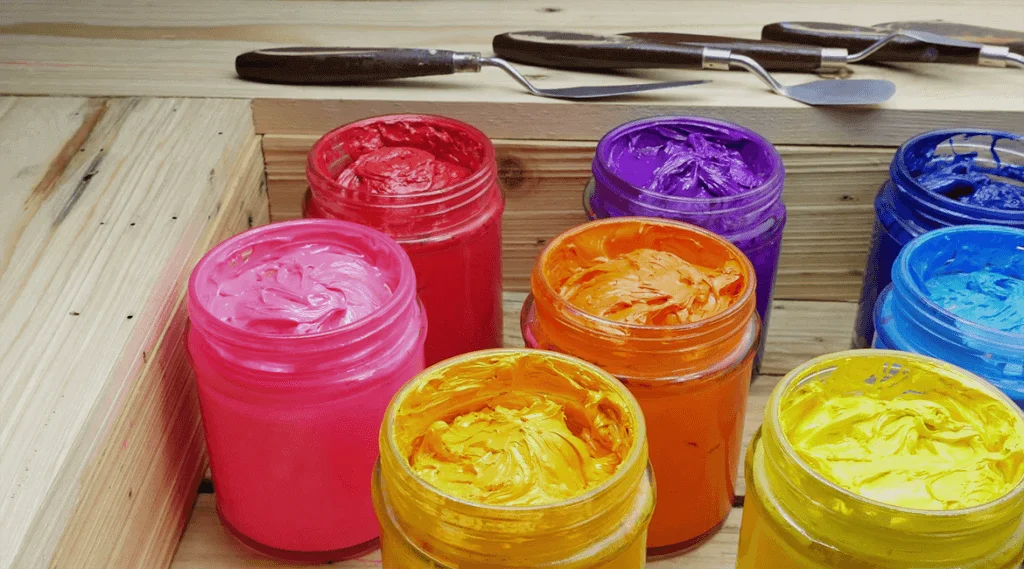
The main inks used in screen printing are plastisol , water-based inks, and solvent-based inks. What are the differences? Let's take a look at the advantages and disadvantages of each type of ink.
Plastisol Inks
Plastisol is a plastic-derived ink that is most commonly used in screen printing T-shirts : it is a ready-to-use, homogeneous liquid mixture that works very well for images with gradients, shadows, and halftones. The beauty of Plastisol lies above all in the accuracy of its colors and their opaque consistency: in fact, thanks to the Pantone Color Matching System® , it is possible to recreate and print even Pantone colors. Plastisol contains resins and plasticizers and therefore requires very high temperatures for the polymer to dissolve in the plasticizer and dry properly. Plastisol is easily printable even with high-thread-count screens and offers particularly bright colors . Furthermore, unlike water-based inks, it allows for a wide range of specialty products and applications. However, because Plastisol is composed of resins and PVC (a suspension of polyvinyl chloride in a plasticizer), it feels rubbery to the touch and is therefore unsuitable for creating a vintage-style print and/or an eco-friendly collection. Although techniques exist to lower the material's viscosity, the result will hardly be comparable to that of a direct-to-garment ( DTG ) print.
Water-based inks
Water-based screen printing inks typically consist of two components: the water base and pigments, which are added to the base to create the colors. These inks are well suited for printing on white and lightweight fabrics and can also be used with screens for natural fabrics and paper. In screen printing, water-based inks are an excellent alternative to plastisol, offering several interesting advantages. Despite not requiring baking, they are equally lightfast and wash-resistant, making them perfect for synthetic fabrics like polyester and acrylic, which cannot withstand high temperatures. Furthermore, they create a soft, vintage-style feel because the ink seeps into the fabric, leaving only a thin layer on the surface. Because water-based inks are plastic- and PVC-free, they are also eco-friendly and easy to use. One of the main disadvantages of this type of ink is that printing with water-based inks on dark fabrics is of inferior quality compared to those obtained with plastisol. Furthermore, water-based inks are much more expensive and difficult to manage, and Pantone colors, halftones, and gradients are more difficult to achieve.
Solvent-based inks
If you want to screen print without using heat presses or ovens, solvent-based ink is the ideal choice! This ink, because it dries at room temperature , retains some of the advantages of water-based ink, allowing it to work on various types of fabrics ( nylon , rayon , polyester , polyamide , and many other types of natural and synthetic fibers ). These inks can have different chemical formulations. The main types are: vinyl, vinyl-acrylic, epoxy, polyurethane, and cellulose. Screen printers choose the most suitable ink based on the substrate and the type of printing. As mentioned above, in the field of fabric screen printing, Plastisol is the most widely used ink for personalized apparel, as it is both cost-effective and qualitatively advantageous (color brilliance, variety of applications, wash resistance). This, in short, is everything you need to know about the main inks for screen printing. To learn more, visit ourprinting techniques section and take a look at some examples of screen printing and direct digital printing. Let us know how we can help you with your next project; visit Burger Print and browse all our customizable screen printing products!