



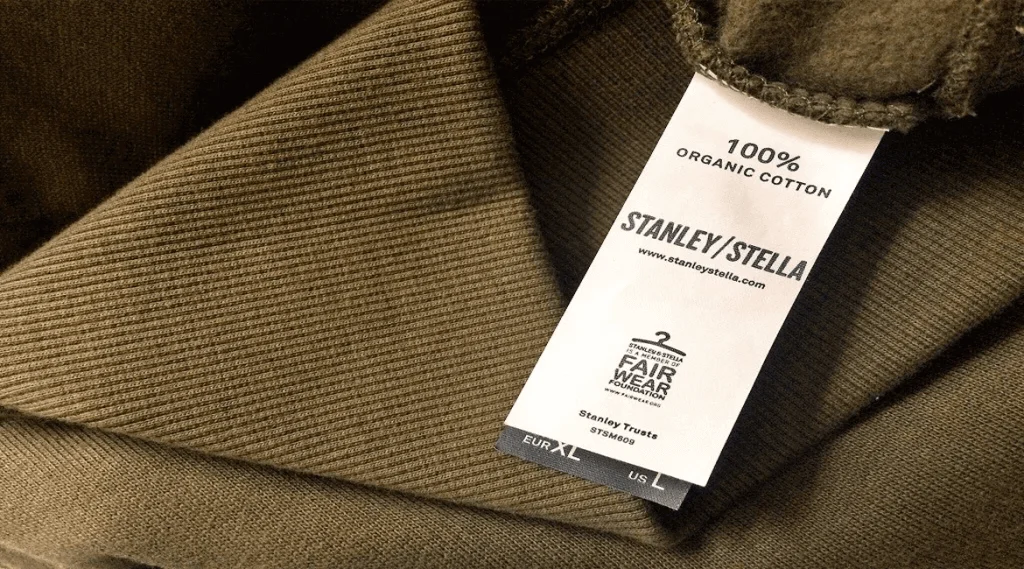
One of the services we offer on Burger-print.nl is inner collar customization. This typically involves removing any existing labels and then customizing the garment according to the customer's needs with an inner collar print or the application of a new custom label. This requirement arises especially for those who want to create their own brand and therefore fully customize the product. However, it's important to consider one key aspect, especially if the product is being manufactured for resale.
At the time of sale, the item must include the information required by law.
In fact, by removing the main label, we create a situation where this information is completely missing from the garment, which will have to be re-applied to the product in some way. Our advice is to take advantage of one of the steps already planned in production to resolve, for example:
- the card, indicating the data on it
- the inner neck print, enriching it with the necessary data
- stickers, specially attached to the head
- applying new specific labels
Don't want to get a headache managing this aspect of mandatory information?
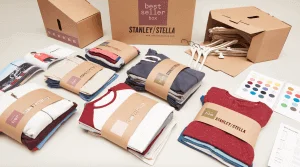
We have the solution for you! Our website , Burger-print.nl, features an entire section dedicated to "no label" products, meaning they're ready to be customized around the neck without having to worry about the mandatory information. These are typically added to a second label on the side, leaving the neck free to be customized as you wish. In case you were wondering, the leading brands for this type of customization are Stanley & Stella and Continental Clothing. If you like a challenge… well, the question arises:
But what is the mandatory information that I should consider including?
Well, to answer this question, we've found a very comprehensive and well-written article that we're attaching. Source: Etichettificio Pugliese. Enjoy!
Labeling in the clothing sector The label is one of the most important tools consumers have to protect themselves. Accurate information and clear content are the first indicators of the manufacturer's reliability and, therefore, the reliability of the purchased product. In addition to the brand name and size, garment labels may contain much more information, including where the product was produced, the materials used, and washing instructions. The information on the garment label must be in Italian and must be clear, easily legible, and not misleading. The label must be applied directly to the garment in such a way as to make it difficult to remove; it must be sewn, stapled, or tied to a drawstring attached to the garment. MANDATORY INFORMATION The label on a clothing product must include references to the manufacturer (name or trademark), meaning the manufacturer of the finished product established in the European Union or any other person presenting themselves as such by placing their name, trademark, or other distinctive sign on the product. If the manufacturer is not located in the European Union, the references must be understood as the first commercial operator located within the EU. The label must also indicate the garment's composition , i.e., the fiber(s) it contains. The rules for completing the composition label differ depending on whether the product is:
- obtained solely from a textile fibre;
- obtained from two or more textile fibres, of which at least one represents 85% of the total weight;
- obtained from two or more textile fibres, none of which accounts for 85% of the total weight.
If the product is made solely from a single textile fiber, the composition label must include the name of the fiber, preceded by the words "100%" or "Pure" or "All." If the product is made from multiple textile fibers, at least one of which accounts for 85%, the composition label may alternatively include:
- the indication of the fibre present in quantities greater than 85%, followed by the relative percentage;
- the indication of the fibre present in quantities greater than 85%, followed by the indication “minimum 85%”
- the complete composition of the product
If the product is made from multiple textile fibers, none of which accounts for at least 85%, the composition label must list at least two of the main fibers present, followed by their respective percentages by weight; the remaining fibers must be listed subsequently, with their percentages by weight. All fibers present in quantities no greater than 10% by weight of the finished product may be listed with the word "Other fibers" followed by the overall percentage; if such fibers are listed, the names must be accompanied by the respective percentages. Labels may also include qualifying information:
- “virgin”: this term is permitted only when referring to wool that has not been incorporated into a finished product and/or has not undergone any other operations or treatments that have damaged its composition, other than those required for the garment's production. When wool is blended with other fibers, the associated term “virgin” may only be used if the fiber accounts for at least 25% of the garment's total weight. “virgin” may be replaced with the term “sheared” (sheared wool).
- “linen blend”: this indication is permitted only for textile products made with a pure cotton warp and pure linen weft, in which linen makes up no less than 40% of the total weight of the fabric; this indication must be followed by the wording “Pure cotton warp and pure linen weft”;
- “various fibres” or “undetermined textile composition”: these indications are permitted in a few very limited cases, and only for those products whose composition is difficult to determine at the time of manufacturing.
For products composed of two or more fabrics, each with a different fiber composition, the composition label must indicate the fiber composition of each fabric, mentioning the component or part to which it refers. Two textile products that are an inseparable whole, as they must be sold together, and that have the same fiber composition may bear a global composition label referring to both pieces. The "Made in…" origin label is mandatory information that manufacturers must declare regarding the country of origin of the product, in compliance with EU legislation. To determine origin, the rules set forth in European customs legislation apply, which establish that the name of the country must correspond to the country where the last substantial transformation or processing that would give the product the characteristics of a new product occurred. The CE marking is mandatory information on products relating to safety and protection. Applied to products destined for European Union markets, it is the manufacturer's means of declaring the conformity of such products to the EU directives establishing their essential and specific requirements. VOLUNTARY INFORMATION Along with the mandatory information, manufacturers can supplement the label with optional information to guide consumers on the characteristics of the purchased product. The most common optional information adopted by industry operators relates to product maintenance and the quality characteristics of the raw materials and/or the production process. Adopted by all commercial operators and widely used on nearly all items marketed, the care label is a highly useful tool for consumers. This label provides information on the treatment techniques for cleaning a garment: it helps maintain its original appearance longer and protects it from irreversible damage during maintenance processes. The pictograms used on care labels are understandable in all countries, regardless of the language spoken; they are supplemented with additional symbols and/or numbers relating to the operating procedures to be followed for each maintenance activity. Care labels may also include additional information that clarifies and complements the care instructions (e.g., "wash separately," "iron inside out," etc.). The care label must be applied directly to the item and be difficult to remove; it must be made of materials resistant to washing and all recommended care treatments; finally, the pictograms must be large enough to be easily readable by the consumer. Other voluntary labels include certification marks issued by recognized organizations (nationally or internationally) to certify that the product has met certain quality parameters and/or more stringent processing methods than those required by current legislation. These are tools for enhancing the eco-efficiency of textile products. Examples include: Ecolabel, Oeko-Tex Standard 100, Global Organic Textile Standard, and Blue Angel Mark.
Controls on the labeling and composition of fashion products are carried out at the national and EU levels. At the national level, control activities are carried out by the Ministry of Economic Development. Supervision is conducted at production laboratories, warehouses, and even retail outlets. This involves verifying the label's contents and declared composition, using laboratories authorized by the Ministry for this latter activity. If a label does not correspond to the product's true composition, or if textile products are found without a label or with an incorrectly filled-out label, sanctions and product recall are applicable.