






The ability to reduce environmental impact has become one of the criteria used to judge the quality or otherwise of a garment. Let's take a look at the main sustainability certifications in textiles, and what they specifically certify.
What are Sustainability Certifications?
A sustainability certification is a certificate, usually issued by independent associations or organizations, aimed at ensuring that a process complies with certain criteria relating to reducing environmental impact.
There are different types of certifications, which cover a wide range of cases.
They are particularly important in the textile industry , as it is known to have one of the largest environmental footprints in the supply chain. It is no coincidence that more and more companies are following the example of Stanley Stella , which, recognizing its role as a brand within the clothing industry, has decided to make minimizing its environmental impact a defining characteristic of its brand.
Certifications can attest to sustainability:
- Of the raw materials used
- The processes used during their manufacturing , such as the use of renewable energy sources and correct waste disposal
- Distribution , that is, packaging and transportation of textile products across multiple continents
Or all of these areas together. Let's see which are the main organizations and what certifications they issue.
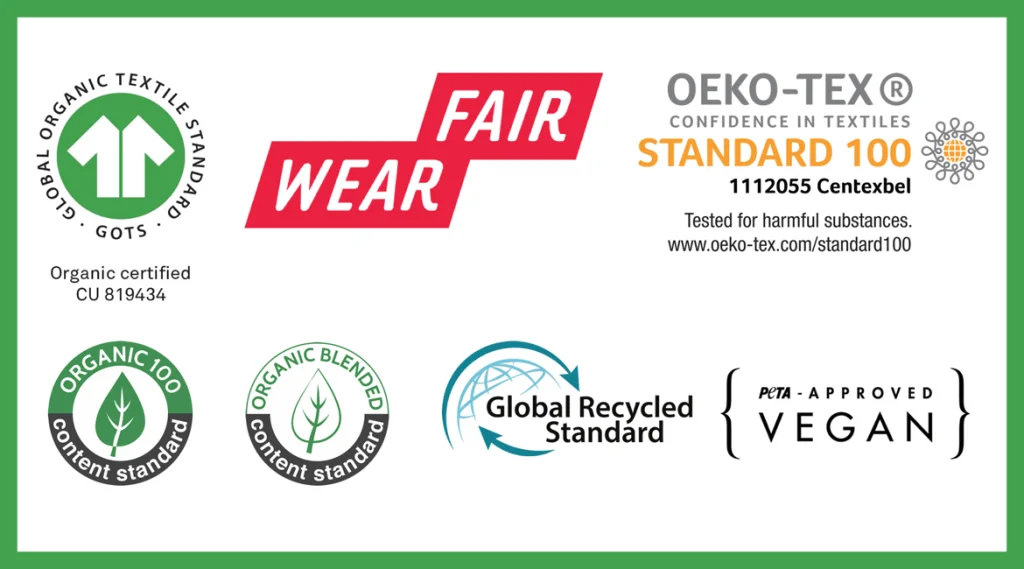
Organic Content Standard (OCS)
The OCS is a certification developed by the Textile Exchange , one of the most important international non-profit organizations committed to promoting new sustainability standards within the textile industry.
This certification is not issued directly by the organization, but rather by third parties known as Certification Bodies. The OCS primarily serves to certify the organic origin of the raw material used. Although it can apply to any type of fiber, it is typically used to certify cotton.
Depending on the percentage of organic fibers contained in the fabric, OCS certification can attest to 100, 95, or a range between 5 and 95% organic fibers.
Global Organic Textile Standard (GOTS)
The Global Organic Textile Standard is widely recognized as the most important international certification . Its importance lies in the fact that the controls and inspections required to obtain it concern not a single aspect, but the entire production chain , from raw material sourcing to finished product packaging.
The certification aims to demonstrate environmental impact throughout the entire supply chain. The organization issues two different types of certificates:
- The so-called Scope Certificates : which certify the conformity of production to the criteria dictated by the organization
- Transaction Certificates: these certify that specific packages being transported contain products compliant with the certification. This creates a "chain of compliance," as the companies purchasing the package can then request to be considered eligible for certification. This is because they use products that have already been certified at the source.
Global Recycle Standard (GRS)
The GRS is an international standard (also promoted by the Textile Exchange) aimed at ensuring a minimum quantity of recycled fibres within the fabric.
Typically, a garment bearing this certification contains between 20 and 100% recycled fibers (cotton, wool, polyester, or leather). Although it is commonly used in the textile industry, the GRS certification is potentially valid for many other materials containing recycled content.
In 2019, nearly 7,000 companies worldwide could boast the certification.
OECO-TEX Certifications
OECO-TEX certifications are among the most widely used in the textile industry. There are various classes, depending on the type of product you wish to certify.
For example, there is a specific subcategory of this certification, called Leather Standard, aimed at controlling fabrics made from animal hides . Or the OECO-TEX STeP variant, which aims to provide multi-level sustainability monitoring , from the correct use of chemicals to environmental performance and social responsibility.
The best-known certification class, however, is the OEKO-TEX Standard 100 , which is extremely important for consumer health. It certifies that any component of a garment, be it a textile fiber, a zipper, or a button, does not contain substances that are toxic or harmful to humans or the environment.
Other types of Certifications or Initiatives
Then there are certifications that are not issued by specialized bodies, but rather by associations that perhaps operate in other fields.
For example, PETA , the famous American animal rights advocacy organization, can issue certifications attesting that a company can be considered 100% vegan . And therefore operate with the utmost respect not only for the environment, but also for animals.
It's also worth noting the presence of initiatives aimed not at certifications, but at reducing the textile industry's environmental impact. This is the case of the Better Cotton Initiative , a field-based program aimed at educating and raising awareness among multiple stakeholders in the textile supply chain. This includes farmers themselves, who are taught the best irrigation techniques to maximize water savings.
Conclusion: Are Sustainability Certifications in Textiles Reliable?
It's a fair question to ask. Especially in a time when news of greenwashing abounds, that is, the strategy of presenting a company as environmentally friendly to win over consumers, when in fact there is no policy aimed at minimizing its environmental impact. A sort of façade of environmentalism, as it's often called.
It is therefore important to emphasize that issuing these certifications is a strictly controlled process. It is no coincidence that third-party certification bodies are almost always used to verify the compliance of corporate practices with the criteria defined by international organizations, thus eliminating any suspicion of alleged agreements.
Furthermore, a distinction must be made between the granting of certification and its maintenance over time . Once certified, companies are often required to undergo periodic audits (usually annual) to renew the validity of the certificate.