




By Burger Print, with a contribution from ChartaRè on packaging.
A merchandise collection can start with an illustration, a business name or a community’s identity. To turn it into clothing people can wear, though, you need to decide how the garments will be used, which styles will carry the artwork and how many pieces to prepare. Even a small project calls for these decisions: adding lots of designs and colours straight away can make it harder to work out which variants to produce and reorder.
Planning the clothing brings the design, garment and production together. Once those elements are settled, the next step is to organise how the finished product will be presented. This article follows the process from choosing a T-shirt to preparing the first batch, with ChartaRè’s contribution on packaging and its practical requirements.
The purpose of the collection
A staff T-shirt needs to make the people at work recognisable and suit their working day. For an event, the link to a particular occasion matters too. With merchandise intended for sale, the design and style need to give people a reason to choose the garment. That affects how prominent the brand is, the fit and the number of variants to develop.
Think of an illustrator who wants to put a series of drawings on T-shirts. They can start with one main design and check how it looks on the chosen style before turning every drawing into a variant. If one image needs a light garment and another only works on black, the colour and size combinations to manage will change as well.
The style and colour are part of the design
The same illustration changes proportion on a regular-fit T-shirt and a looser style. The structure of the fabric also contributes to the result. When choosing the garment, it helps to consider appearance, use and available sizes together, rather than leaving the style until after the artwork has been finished.
The fabric colour becomes part of the composition. A dark detail may lose contrast on blue; a white area in the file may belong to the design or simply be a background you do not intend to print. Clarifying these elements before production helps prepare the file for the intended result. If you offer different colours, each combination needs to be viewed in its own version.
Artwork that works on fabric
On a screen, you can enlarge a line of text as much as you like. On the garment, it will have a fixed size and may be read from a distance. Printing the design on paper at its intended size helps you check whether words and details remain legible before discussing how the personalisation will look on fabric.
Position and size need to be considered together. A design close to the neckline can have a different effect from the same artwork placed lower down; a wide composition may need adapting to the chosen style. Keeping the editable original lets you prepare these versions without rebuilding the project from a screenshot. For pixel-based images, quality needs to be assessed at the final size.
The production method and quantities go together
The production choice depends on the combination of garment, artwork and batch size. An illustration with lots of gradients has different requirements from a few-colour text design. When comparing the available methods, detail reproduction, the requested placement and any setup costs spread across the number of pieces all matter. A useful recommendation starts with the actual artwork and planned quantities.
For the illustrator, developing several designs can therefore change the quote too. Before confirming the collection, it helps to compare complete configurations: the same style, quantities per design, print positions and garment colours. The cost of a T-shirt with one design does not describe the cost of a collection with many variants.
The artwork proof and the sample answer different questions
For Burger Print’s personalised T-shirts, after the order we check the artwork and send the customer a proof to approve before production. This is the point to check the design version, size and position on the chosen style. If a correction is made, that version needs to become the shared reference before production starts.
A physical sample is used to assess other aspects: fabric, fit, colour and the finish of the personalisation. If these characteristics are crucial to the collection, ordering a garment to test allows you to judge them directly. The size used for the test also matters: the result on one sample does not replace the information needed to choose the range you will sell.
A first batch you can reorder
Quantities should start with the project’s needs. For staff, you can collect the sizes of the people involved; for a collection intended for sale, you need to plan an assortment without yet knowing how demand will be distributed.
The illustrator imagines a first batch of 100 T-shirts: 50 white and 50 black. It seems like a simple assortment until five sizes and three designs are added. There are now thirty possible combinations; if the pieces were shared evenly, each would have only three or four. One size can sell out quickly while another design remains unsold. Limiting the initial designs, or collecting audience preferences before placing the order, helps you decide where to concentrate the batch.
A focused assortment makes the results of the first batch easier to understand. Keeping a record of the style, colour, approved artwork and production details then helps prepare the reorder. Before promising further availability to your audience, check the garment and the conditions of the next supply: the design can stay the same even when catalogue availability changes.
From finished garment to packaging
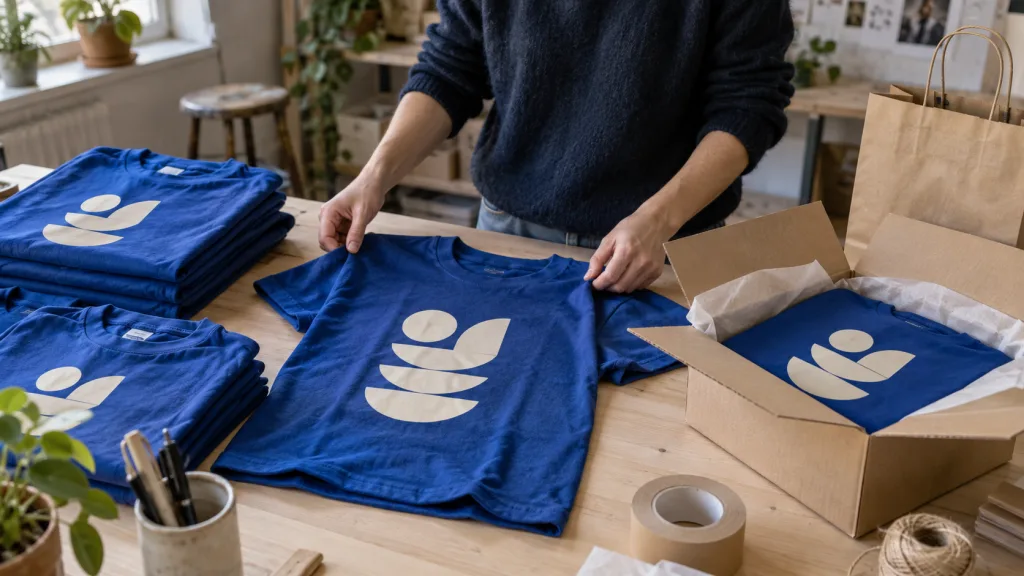
Once the T-shirt is defined, the packaging can be assessed around the actual product. The folded garment, any inserts and the way it will be handed over or shipped become useful information for whoever handles the packaging. At this stage, the clothing project meets a different area of expertise. To explain where to start, we turn to ChartaRè, specialists in packaging design and supply, for their contribution.
A merchandise collection has an identity: it starts with an idea, speaks to an audience and tells a brand’s story. Packaging can carry that project forward, accompanying the garment from purchase to the moment the package is opened.
At ChartaRè, we start by listening. We want to understand who is offering the collection, which customers it is aimed at, where the products are sold and how they are delivered. We consider the budget, planned quantities and available space. For a small collection, this information helps us choose well-considered packaging that fits the project and is straightforward to prepare and reorder.
With ChartaRè Packaging Lab, we turn these needs into a study and design service provided free of charge. We select carrier bags, boxes, wrapping papers, ribbons and labels, and develop a proposal coordinated with the collection’s identity. Each element has a job: containing, protecting or presenting the garment, or making the brand recognisable. Colours and artwork are distributed across the different surfaces to create a balanced whole.
We also think about what will happen after the launch. If the T-shirt illustrations change frequently, for example, we can design packaging centred on the brand and use a label or insert to identify the individual collection. Existing packaging stock can then be used for future releases too.
Our work continues with the quote, supply and organisation of reorders. When the customer has limited space, we can agree to store the goods and deliver them in the quantities and at the times requested, without additional costs for the agreed service.
The person developing the collection therefore has one point of contact for packaging, from the first idea to managing the packaging used every day.
Keeping the project together
Before launch, testing a complete order shows how the decisions come together: the chosen garment, approved artwork, purchased combination and the packaging in which it will reach the recipient. Any corrections can then be shared with the people handling the clothing and packaging.
The work on the first batch also becomes the reference for the next one. A new illustration can join the collection while retaining the style and presentation already checked, whereas a change of garment means revisiting the choices that depend on its characteristics.
To start planning your project, explore the selection of custom T-shirts and compare styles, colours and quantities for your collection.